Business cases often turn on the complaint before anyone reaches discovery. If the pleading skips key facts, leans on labels instead of details, or never connects the defendant’s conduct to a recognized legal theory, the case can be cut down early and force a reset. In practice, that changes leverage, expense, and timing as much as it changes the legal posture.
The real question is whether the complaint contains enough facts to get past the pleading stage.
- In federal court, the main tool is a Rule 12(b)(6) motion, which tests the sufficiency of the complaint, not the truth of the plaintiff’s story.
- Judges accept well-pleaded facts as true, but they do not accept bare legal conclusions or recitations of elements.
- Business claims often fail when they omit contract terms, dates, speakers, documents, or a clear link between conduct and harm.
- Fraud and similar claims usually need more detail than ordinary contract disputes because the pleading rules demand greater specificity.
- A dismissal may be with or without prejudice, so the real consequence depends on whether amendment is still available.
- State court practice can be similar, but the exact motion, timing, and local standards vary by jurisdiction.
What this defense means in business litigation
In federal practice, I treat this as a threshold pleading question, not a merits fight. The court asks whether the complaint includes enough factual content to support a recognized cause of action, or whether it is mostly labels, conclusions, and hope. If the answer is the latter, the defendant can ask for dismissal at an early stage, before the case expands into full discovery.
The point is narrower than many business owners expect. A court does not decide at this stage whether the plaintiff will ultimately win. It decides whether the facts alleged, if taken as true, plausibly show entitlement to relief. That is why a weak complaint can be vulnerable even when the underlying dispute feels real and commercially significant.
That distinction matters in contract disputes, ownership fights, fraud allegations, and boardroom conflicts where the first filing often tries to do too much with too little detail. Once you see the line between a plausible factual claim and a thin pleading, the next question is what the complaint actually needs to contain.
What a complaint must actually allege
Rule 8 requires more than a short story. It requires a short and plain statement showing why the plaintiff is entitled to relief, plus a demand for relief. In plain English, the complaint needs enough facts to let the court see the legal theory, the defendant’s role, and the injury that flowed from the conduct.
When I review a business complaint, I usually look for four things:
- A specific legal theory, not just a grievance.
- Concrete facts tied to each element of that theory.
- A clear connection between the defendant’s conduct and the alleged harm.
- A request for a remedy that matches the claim.
That sounds basic, but business pleadings often fail because they are built around general accusations rather than element-by-element facts. A breach of contract claim should identify the contract, the relevant term, the breach, and the resulting damage. A fraud claim needs even more detail, because the rules require particularity about the circumstances of the alleged misrepresentation.
In other words, the complaint has to move from “something went wrong” to “this defendant did this thing, on this date, in this way, and it caused this loss.” If the pleading cannot make that move, the defense has a real opening.
How judges decide whether the complaint survives
When a judge evaluates the motion, the focus is on the face of the complaint and any properly considered attachments. Well-pleaded facts are assumed true, but legal conclusions are ignored. The court then asks whether the facts make liability plausible, not merely possible.
I find that business litigants often underestimate how important that plausibility test is. A complaint can be detailed and still fail if the details do not actually support the legal elements. A complaint can also be sparse and still survive if the facts, though limited, are enough to suggest a real claim.
There is another procedural trap here. If a party starts introducing materials outside the pleadings, the court may have to treat the motion as one for summary judgment instead. That matters because summary judgment is a different stage, with different evidentiary rules and a different strategic posture. Defendants should not casually turn a pleading motion into an evidence fight unless they are ready for that shift.
Another useful procedural point: the same sufficiency issue can be raised in the answer, in a Rule 12(c) motion after the pleadings close, or even at trial in limited circumstances. That means the defense is preserved more broadly than some other Rule 12 objections. The question is not only whether the defense exists, but when it is smartest to press it.
Where business complaints most often fall short
Most weak business complaints do not fail because the law is exotic. They fail because the facts are underdeveloped. The plaintiff names the dispute, but not the specific conduct that turns the dispute into a viable legal claim.
| Claim type | What is often missing | Why that matters |
|---|---|---|
| Breach of contract | The actual contract term, the breach date, or the promised performance | Without those facts, the court cannot tell what obligation was broken or how |
| Fraud or misrepresentation | Who said what, when it was said, where it happened, and why it was false | Fraud claims need particularity, so vague accusations usually do not survive |
| Fiduciary duty | Facts showing the duty itself and the specific disloyal act | A duty is not assumed just because the parties had a business relationship |
| Tortious interference | A real third-party relationship, intentional interference, and causation | If the pleading never identifies the disrupted business relation, the theory stays abstract |
| Unjust enrichment | The benefit conferred and why keeping it would be inequitable | Courts need more than the assertion that the defendant profited unfairly |
The pattern is consistent: the legal label is present, but the factual bridge is missing. That is exactly the kind of defect defendants look for in commercial litigation, and it leads naturally to the question of how this motion differs from other early defenses.
How this differs from jurisdiction, judgment on the pleadings, and summary judgment
Business litigants often mix up these devices because they all can end a case early. They are not the same thing, and treating them as interchangeable usually causes bad briefing.
| Procedure | What it tests | When it is used | What the court generally looks at |
|---|---|---|---|
| Rule 12(b)(6) | Whether the complaint states a plausible claim | Usually before the answer, though not always | The complaint and materials properly tied to it |
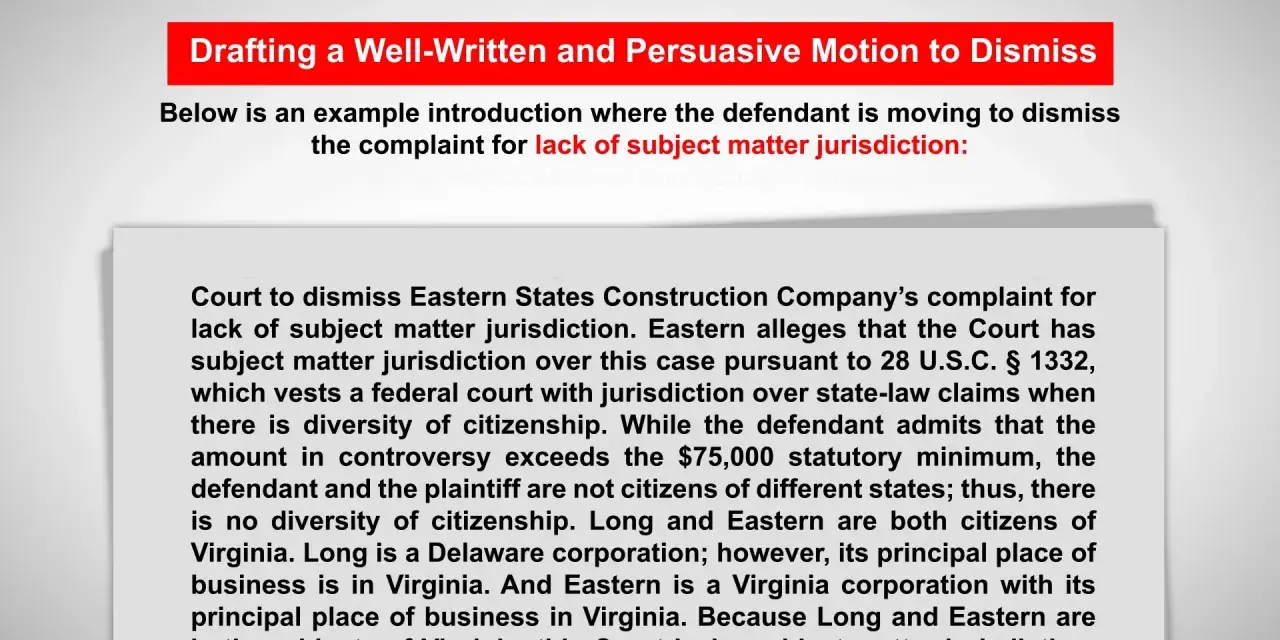
| Rule 12(b)(1) | Whether the court has power to hear the case | At any time if jurisdiction is missing | Sometimes evidence beyond the complaint |
| Rule 12(c) | Whether the pleadings support judgment on the pleadings | After the pleadings are closed | The pleadings themselves |
| Rule 56 | Whether there is a genuine dispute of material fact | After discovery or when evidence is ready | Evidence, not just pleading allegations |
The practical takeaway is simple. Jurisdiction asks whether the court can hear the case. A pleading motion asks whether the complaint is good enough. Summary judgment asks whether the evidence can carry the claim. Once you keep those boxes separate, the strategy becomes much cleaner.
How to respond when the motion lands on your desk
If I am representing the plaintiff, my first task is to map each element of the claim to a concrete fact. If an element has no factual support, I fix that immediately. If the problem is simply that the complaint was written too broadly, an amended complaint may solve it faster than fighting over motion practice.
Federal Rule 15 gives plaintiffs meaningful room to amend, and courts generally prefer deciding cases on the merits rather than on a thin first draft. But that leniency is not unlimited. If the amendment would be futile, or if the case has already moved into a stage where a scheduling order matters, the plaintiff may need a stronger explanation and a faster response.
If I am representing the defendant, I usually avoid overreaching. The best motion is often the one that strips away the weakest claims and narrows the case, not the one that tries to demolish everything at once. I also avoid relying on outside evidence unless I am ready for the motion to shift into a different procedural posture.
In business litigation, timing matters as much as substance. A defendant who forces an early amendment may reduce discovery pressure. A plaintiff who fixes the pleading quickly may preserve momentum and avoid unnecessary delay. The smarter move depends on which side of the table you are on, but the procedural clock is always running.
What dismissal changes and what it does not
A dismissal on pleading grounds does not automatically mean the underlying facts are false. It means the court was not given enough well-pleaded facts to let the claim move forward in its current form. That is a narrower ruling than a finding on the merits, and the difference matters.
If the dismissal is without prejudice, the plaintiff may be able to amend and try again. If it is with prejudice, the claim may be over in that case, and sometimes the practical effect is close to final. In either event, the dismissal can reshape settlement leverage, discovery scope, and the posture of the entire dispute.
For companies, that is the real business value of this defense. It can force a cleaner pleading, eliminate weak theories, and prevent expensive discovery from opening before the plaintiff has done the work required by the rules. That is why the complaint itself is often the first serious battleground.
The checklist I would use before filing or attacking a business complaint
When I want to know whether a business complaint is vulnerable, I run a simple checklist before I look at anything else:
- Identify the exact claim and list its elements.
- Match each element to at least one concrete fact.
- Name the contract, communication, transaction, or decision at issue.
- Check whether the pleading shows who did what, when, and how.
- Apply Rule 9(b) if fraud, mistake, or special damages are involved.
- Separate pleading defects from jurisdiction problems.
- Decide whether amendment will cure the problem faster than motion practice will.
- Confirm the local federal or state rule set before filing anything strategic.
If a complaint cannot survive that pass, it is probably too thin for serious business litigation. If it can, the defense may still narrow the case, but it will need a more targeted strategy than a generic motion to dismiss.