Business disputes over creative assets usually come down to a few practical questions: who owned the work, what rights were actually licensed, whether the use was protected, and how much exposure the company really has. In practice, copyright litigation is less about abstract doctrine than about contracts, timestamps, emails, screenshots, and whether both sides can still resolve the matter before costs outrun the claim. This article breaks down how these disputes work in the United States, what remedies are at stake, and how I would approach the problem if a demand letter landed on my desk.
What matters most when a copyright dispute becomes a business problem
- Most disputes start with a notice letter, takedown request, or licensing demand, not a filed complaint.
- For a U.S. work, registration timing can determine whether a lawsuit can be filed and whether statutory damages and attorney’s fees are available.
- Federal court and the Copyright Claims Board serve different business needs; the right forum depends on the amount in dispute, the urgency, and the complexity of the ownership record.
- Fair use is fact-specific, and there is no safe percentage or word count that automatically makes copying lawful.
- The strongest business defense is usually a clean paper trail: assignments, licenses, approvals, and preservation of evidence.
What copyright disputes usually look like in a business context
When companies talk about copyright, they often focus on obvious copying. In real disputes, the facts are usually messier. The problem may involve a reused photo in a campaign, a video clip embedded in a landing page, text lifted from a competitor, software code carried over by a contractor, or a music track used in social content without the right sync license. I also see a lot of conflict around the scope of permission: a license that covered one channel, one territory, or one time period gets stretched past its actual limits.
That is why these cases are often not just about infringement. They are about ownership, scope, and recordkeeping. A work created by an employee, a freelancer, or an agency can look straightforward until the agreements are checked. If the chain of title is weak, the case can shift from “who copied what” to “who actually owned the right to use it.”
- Marketing assets - photos, illustrations, copy, and video snippets reused after a campaign or license expired.
- Digital products - code, UI assets, documentation, and training materials reused across vendors or teams.
- Publishing and media - reposted articles, excerpts, images, and embedded content without a clear license.
- Social content - clips, memes, music, and creator content used for brand promotion.
- Vendor work - agency deliverables that were paid for but never cleanly assigned to the business.
In short, the legal issue is rarely only “did someone copy?” It is also “did the business have the right to do it, and can it prove that right quickly?” That distinction matters because it shapes everything that follows, from the first letter to the forum the claim ends up in.
When a dispute turns into a lawsuit
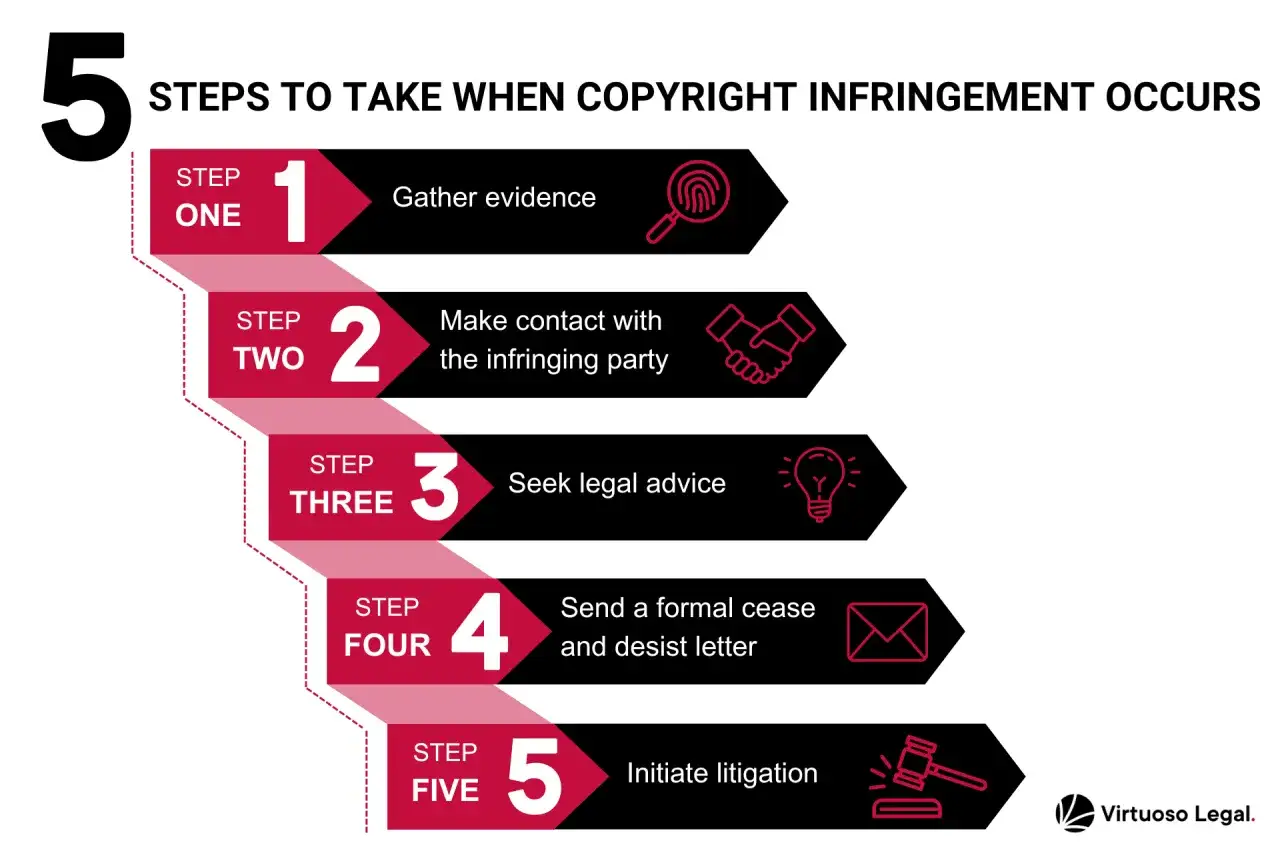
Most copyright disputes start before any courtroom filing. The first move is often a cease-and-desist letter, a takedown notice, or a settlement demand asking for removal, attribution, a retroactive license, or money. If the issue is online, a DMCA notice-and-takedown can become part of the picture, especially when the owner wants the content removed quickly while the parties argue about liability in the background.
For a U.S. work, registration is the practical gatekeeper. A copyright owner generally needs registration before filing an infringement suit, and timely registration also affects the availability of statutory damages and attorney’s fees. The current fee schedule is not large compared with litigation costs; the Copyright Office currently lists basic online filing at $45 for a single-author, same-claimant, one-work, not-for-hire claim, $65 for the Standard Application, and $125 for paper filing. If a business thinks the dispute might escalate, that is usually cheap insurance. A registration certificate filed before, or within five years after, publication can also help as evidence of validity.
Timing matters again on the back end. A civil copyright claim generally has a three-year limitations period, so waiting too long can narrow options even when the facts look strong. The practical lesson is simple: if you receive a claim, treat the timeline as seriously as the substance. That leads naturally to the next question, which is where the dispute belongs if it does move forward.
Federal court or the Copyright Claims Board
Not every copyright dispute belongs in federal court. For some businesses, the better route is the Copyright Claims Board, the small-claims forum built for narrower disputes. For others, federal court is still the only sensible option because the case is larger, more technical, or tied to broader contract and ownership issues. I usually separate the choice by asking three questions: how much money is really at stake, how much discovery will be needed, and whether the parties care more about speed or precedent.
| Forum | Best for | Main advantages | Limits |
|---|---|---|---|
| Federal court | Higher-stakes disputes, injunction requests, ownership fights, and cases needing full discovery | Broader remedies, full procedural tools, stronger pressure in complex disputes | More expensive, slower, and usually more demanding on evidence and motion practice |
| Copyright Claims Board | Smaller disputes, especially where the amount in controversy is limited | Streamlined process, limited discovery, lower cost, designed for faster resolution | Respondent can opt out, damages are capped, and the decision does not create precedent |
| Settlement or mediation | Cases where the parties need to preserve a business relationship or control cost | Flexible, confidential, and often faster than formal litigation | Depends on compromise; no binding result unless the parties agree |
The Copyright Claims Board is voluntary and capped at $30,000 total, with streamlined procedures and limited discovery. That makes it a realistic option when the dispute is real but not worth federal-court drag. The tradeoff is that the respondent can opt out, and the board is not a substitute for a full federal case when the business impact is large or the ownership record is disputed on multiple fronts. Once you know the forum, the next issue is whether the claim itself is actually strong.
What a claimant has to prove and what usually defeats the case
At a basic level, a claimant needs to show ownership of a valid copyright, copying of protected expression, and enough similarity to make the copying legally meaningful. That sounds simple, but the fight usually happens in the details. What exactly was copied? Was it protected expression or only an idea, fact, method, or generic layout? Did the accused user have permission? Was the material independently created? Was the use so transformed that it fits within fair use?
Fair use is where many business defendants spend time and money, and for good reason. Courts look at the purpose and character of the use, the nature of the work, the amount taken, and the effect on the market. I do not think of fair use as a percentage game. There is no magic number of words, seconds, or pixels that makes a use safe. A short clip can still be unlawful if it captures the heart of the work, while a larger use may be defensible if it is genuinely transformative and does not substitute for the original market.
- License or permission - the business had the right to use the work, even if the paperwork was incomplete.
- Independent creation - the accused material was created separately, without copying the protected expression.
- Public domain or uncopyrightable material - the work was never protected, or only unprotected elements were used.
- Fair use - the use was commentary, criticism, reporting, research, teaching, or another defensible transformative use.
- No valid ownership chain - the claimant cannot connect the copyright to a clean record of authorship or assignment.
For businesses, the hard lesson is that legal strength and evidentiary strength are not the same thing. A potentially valid defense can still be expensive to prove if the company did not keep the right files. That is why remedies and settlement leverage matter so much in these cases.
Remedies and the pressure points that drive settlement
Once liability is plausible, the case usually turns into a numbers problem. A copyright owner may seek actual damages, the infringer’s profits, an injunction to stop further use, and, in some cases, attorney’s fees and costs. In federal court, statutory damages can be especially important because they allow a recovery that does not require proving exact market loss. The current ceiling is up to $30,000 per work, and up to $150,000 per work if willful infringement is proven. But those stronger remedies are not always available; timely registration is what keeps them in play.
That timing rule changes settlement pressure. If the work was registered before infringement, or within three months of first publication, the claimant is in a much better position. If it was not, the case often becomes a lower-dollar damages fight and a higher-stakes cost fight. That is one reason many disputes settle before full discovery: the legal merits matter, but the cost of proving them can overwhelm the value of the underlying use.
- Actual damages - the measurable economic loss tied to the infringement.
- Infringer profits - gains tied to the unlawful use that are not already counted as damages.
- Injunctions - court orders that can force removal, redesign, or cessation of use.
- Fees and costs - potentially recoverable in federal court, which can change settlement leverage fast.
In my experience, the pressure point is usually not one giant damages number. It is the combination of possible injunctions, discovery burden, and legal fees. That is why the first 72 hours after a claim arrives matter so much.
The first 72 hours after a claim lands on your desk
I treat the first response as an evidence-preservation exercise before it is an argument. If the company reacts emotionally, deletes files, or starts rewriting history, the business creates a second problem that is often worse than the first. A disciplined response gives you room to evaluate exposure without making admissions you do not need to make.
- Preserve everything - emails, drafts, upload logs, contracts, invoices, source files, screenshots, and approval records.
- Stop or quarantine the use - do not keep exploiting the challenged asset while you are still figuring out rights and risk.
- Rebuild the rights chain - identify who created the work, what the contract says, what was paid for, and what was actually assigned.
- Check the dates - publication, registration, first use, takedown, and any renewal or license expiration dates.
- Price the options - compare settlement, remediation, CCB, and federal-court exposure before anyone starts bluffing.
One thing I would avoid is sending a fast, overconfident reply that denies everything without a factual review. That can lock a company into a position it later cannot defend. A cleaner approach is usually to acknowledge receipt, preserve the record, and respond once the rights picture is clear. The final question is how to keep the same issue from resurfacing six months later.
The records that keep a small dispute from becoming expensive
The best defense against a future claim is not a clever argument after the fact. It is a boring, reliable rights-management system before publication. If I were advising a business that creates or buys content regularly, I would focus on a few habits: signed assignments for every outside creator, license files attached to every asset, a single person responsible for approvals, and a calendar for registration and renewal decisions. That is the real business-law angle here: reduce ambiguity before someone else turns it into leverage.
- Use written assignments for contractors, agencies, designers, developers, and photographers.
- Track every license by scope, territory, channel, duration, and permitted edits.
- Keep proof of approval for every campaign, landing page, product release, and content update.
- Save source files and metadata so authorship and timing can be reconstructed later.
- Register strategically when the work is important enough that statutory damages and fees would matter.
If I had to reduce the whole topic to one rule, it would be this: make ownership and permission easy to prove before launch, not after a demand letter. That single habit prevents a surprising amount of copyright litigation and gives a business far more leverage when a dispute does arise.