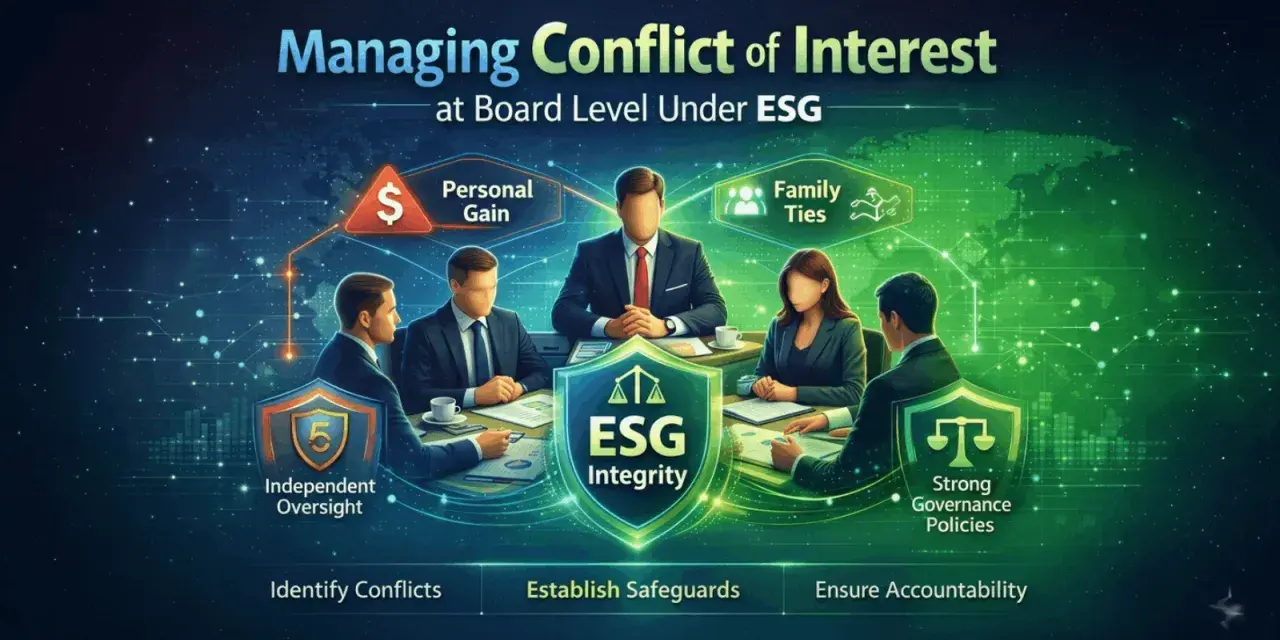
In U.S. board governance, the standard response is straightforward: disclose the facts, step back from the decision when needed, and document the process clearly. The sections below explain how conflicts show up, how to manage them, and what a policy should require if you want the board to stay credible under pressure.
Key points to know before a board makes a decision
- A conflict exists when a person’s private interest could influence, or appear to influence, board judgment.
- Disclosure is necessary, but disclosure alone is not always enough; recusal is often the safer next step.
- Common boardroom triggers include related-party contracts, compensation votes, family ties, vendor selection, and outside business roles.
- Good governance depends on a written process, not improvisation in the meeting room.
- The strongest boards record the facts, exclude conflicted directors from the vote, and use independent review when the issue is material.
What the term means in board governance
At board level, a conflict of interest is not just about obvious corruption or someone “doing something wrong.” It is broader than that. A conflict exists when a director’s or officer’s personal interest could interfere with the duty to act for the organization, not for themselves. That personal interest might be financial, but it can also come from a family relationship, a second job, a consulting arrangement, equity ownership, or a future business opportunity.
I think the cleanest way to understand it is to separate three ideas. An actual conflict exists right now. A potential conflict could arise later if the facts change or the board moves forward. An apparent conflict may not prove wrongdoing, but it still creates a reasonable question about independence. In board governance, appearances matter because trust is part of the asset.
That distinction becomes important because boards are expected to exercise the duty of loyalty. In plain English, that means directors must be able to say, with a straight face, that the organization’s interests came first. When that is uncertain, the board needs a process, not a guess.
Once that definition is clear, the next question is where conflicts usually show up in real boardroom work.
The situations that usually create risk
Most board conflicts do not arrive as dramatic scandals. They show up in ordinary decisions that suddenly become sensitive because someone has something to gain, protect, or influence. Here are the patterns I see most often.
| Situation | Why it is risky | Best first response |
|---|---|---|
| A director owns, works for, or advises a vendor being considered by the board | The director may benefit directly from the contract or influence the selection process | Disclose fully, step out of discussion, and let independent directors compare bids |
| A family member stands to gain from the decision | The benefit may be indirect, but it can still shape judgment and raise appearance concerns | Disclose the relationship early and document whether recusal is required |
| The board is voting on compensation, bonuses, or benefits | Pay decisions are a classic self-interest trigger, especially when the person voting may receive similar treatment | Use independent directors or a committee, and keep the conflicted person out of the vote |
| A director has an outside board seat, consulting role, or competitor relationship | Loyalty can become divided, and access to information may create a second set of obligations | Assess whether the outside role is compatible and restrict participation where needed |
| The board is selecting a major donor, investor, buyer, or partner with personal ties to a director | The stakes are high enough that a small bias can distort a major decision | Use independent review, competitive comparison, and careful minutes |
These cases matter because they are rarely about one giant ethical failure. They are usually about a board letting a familiar relationship sit too close to a decision. I would rather see a board over-disclose than under-disclose, because ambiguity is where governance tends to fail.
Once you can spot the common triggers, the practical issue becomes how to disclose and document them without creating confusion in the meeting itself.

How boards should disclose and document a conflict
Disclosure is not a formality. It is the point where the board gets enough information to decide whether the conflicted person can stay in the room, whether the matter needs independent review, or whether the transaction should be stopped. A vague statement like “I may have an interest here” is usually too weak to be useful.
Good disclosure should name the relationship, the type of benefit, and any facts that would matter to an independent director. If the issue involves money, say how much and when. If it involves a relationship, say who it is and how the connection works. If it involves an outside business role, explain whether the role could influence the decision.
- State the conflict before the discussion begins, not after the board has already leaned in one direction.
- Describe the relevant facts clearly enough that the other directors can judge the risk for themselves.
- Tell the chair, governance committee, or general counsel if the issue is material or sensitive.
- Record the disclosure, the board’s response, and the recusal in the minutes.
- Update the disclosure if the facts change before the final vote.
Disclosure and recusal are not the same thing. Disclosure informs the board. Recusal removes the conflicted person from the part of the process where independence matters. In some situations, disclosure is enough to let independent directors proceed. In others, the person should leave the discussion entirely, not just abstain at the end.
The IRS encourages charities to use written procedures that require disclosure and excuse conflicted individuals from voting, and that logic holds up well beyond the nonprofit world. If the board gets the disclosure right, the next task is deciding what action the conflict requires.
What to do once the conflict is identified
The right response depends on severity. Some conflicts can be managed cleanly. Others should stop the transaction before it goes any further. The mistake many boards make is assuming every conflict can be solved with a quick abstention. That is not always enough.
When the conflict is modest and the board can still make an independent decision, the response may be straightforward: recuse the interested person, collect independent bids or valuations, and let the disinterested directors decide. When the conflict is material, the board may need a committee of independent directors, outside counsel, or a third-party fairness review. And when the conflict cannot be separated from the decision, the clean answer is to reject or unwind the transaction.
- Recuse the conflicted director from discussion, not just the vote.
- Move the decision to independent directors or a committee if the issue is sensitive.
- Use market checks, competitive bids, or outside valuation where money or control is involved.
- Have counsel review related-party transactions, executive pay, or major vendor decisions.
- Walk away if the conflict cannot be disclosed and mitigated in a way that preserves independence.
The cleanest boardroom answer is often the least glamorous one: remove the pressure point, get independent review, and keep the record tight. If the conflicted person’s presence changes the conversation, the process is already compromised.
That is why weak conflict handling can damage more than the transaction itself.
Why weak conflict handling erodes trust fast
A board does not lose credibility only when a bad deal closes. It loses credibility when the process looks sloppy, defensive, or uneven. Once that happens, every later decision becomes harder to defend. Other directors start second-guessing one another. Executives start treating the board as political instead of independent. External stakeholders notice, and they rarely forget.
There is also real legal and operational risk. A conflicted decision can trigger challenges to the fairness of the process, problems with minutes, scrutiny from auditors, or claims that the board did not exercise proper oversight. In the U.S., public companies, nonprofits, and regulated firms all face different rules, but the underlying governance problem is the same: if the board cannot show a disciplined process, the decision becomes vulnerable.
That is why I treat conflict management as a board culture issue, not only a compliance issue. A board that normalizes disclosure, asks follow-up questions, and documents recusals is usually a board that takes its fiduciary role seriously. A board that shrugs off small conflicts usually has larger problems waiting underneath.
To keep that from happening, the board needs a policy that works in real life, not just on paper.
What a strong conflict policy should actually include
A usable policy does more than define the term. It tells directors and officers what to do when the issue appears, who reviews it, how fast disclosure must happen, and what gets written into the record. That is the difference between a policy that protects the organization and one that only looks good in a binder.
I would expect a strong policy to cover these points:
- A clear definition of actual, potential, and apparent conflicts.
- Examples tailored to the organization’s real risks, such as vendor relationships, family ties, equity interests, outside employment, gifts, and related-party transactions.
- A written disclosure process for directors, officers, and key employees.
- Rules for recusal, including whether the conflicted person may stay for discussion.
- Authority for independent directors, a governance committee, or counsel to review borderline cases.
- Documentation standards for minutes, approvals, and follow-up.
- Consequences for failing to disclose or trying to steer the outcome anyway.
- A regular review cycle so the policy stays aligned with the organization’s current risks.
The SEC’s conflict guidance for regulated firms treats conflict management as an ongoing process, not a one-time checkbox exercise, and that is the right mindset for boards too. If your policy only comes out after a problem appears, it is already too late. It should be part of the board’s operating rhythm, not an emergency document.
The real test is whether directors can identify a conflict early, say it plainly, and step aside without drama when the situation calls for it.
The boardroom test I use before any vote
Before any sensitive vote, I ask three questions. Would this decision benefit the person involved, or someone close to them? Would an outside observer question the board’s independence if they saw the relationship? Could we defend the process in the minutes without sounding evasive? If the honest answer to any of those is no, the board should slow down, disclose the issue, and redesign the decision process before money or trust is at risk.
That discipline is what turns a conflict policy into real governance. It keeps directors focused on the organization’s interests, which is the only position that holds up when scrutiny arrives.