
An executive board chair is not a ceremonial label; it is the role that keeps board governance disciplined, strategic, and legally grounded. In U.S. boards, the quality of the chair often determines whether directors spend their time on oversight and judgment or drift into management detail. This article breaks down what the role really owns, how it differs from the CEO and other board leaders, and what strong chairs do to keep meetings, decisions, and succession on track.
What matters most is keeping governance separate from management
- The chair leads the board’s work and keeps discussion focused on oversight, strategy, and accountability.
- The role may be separate from the CEO or combined with it, depending on the organization’s structure.
- Strong chairs shape agendas, manage boardroom dynamics, and protect the board’s decision-making quality.
- Succession planning is part of the job, not an afterthought.
- Good chair leadership is measured by board performance, not by how much management work gets absorbed into the role.
What the chair actually owns
I think of the chair as the board’s operating system: it is the structure that makes the rest of the board usable. The chair leads the board, sets the cadence of its work, and keeps the conversation aligned with mission, risk, and strategy. BoardSource describes the chair as the person who leads the board and supervises the chief executive, and it also notes that many boards still struggle with preparation, with almost 23% electing the only willing candidate and 15% selecting someone not fully ready to serve.
That means the chair’s work is broader than running meetings. A serious chair is usually responsible for all of the following:
- building agendas around decisions, not just reports
- making sure committee work supports board priorities
- keeping individual directors engaged and accountable
- creating room for dissent without letting meetings become chaotic
- overseeing the CEO relationship, evaluation, and development process
In practice, the chair is the person who keeps the board from becoming either passive or managerial. Once that boundary is clear, the next question is how the chair relates to the CEO and the rest of the leadership structure.
How the role differs from the CEO, lead director, and vice chair
This is where boards make avoidable mistakes. The chair leads governance; the CEO runs operations; the lead independent director protects board independence when the chair and CEO roles overlap; and the vice chair provides continuity and often serves as the successor-in-training. NACD points out that corporations are not legally required to give anyone the chair title, which is exactly why boards need to choose a structure intentionally rather than inherit one by habit.
| Role | Primary focus | What good looks like | Common failure mode |
|---|---|---|---|
| Chair | Board governance, agenda-setting, oversight, culture | Keeps directors focused, prepared, and aligned | Either dominates the room or disappears when judgment is needed |
| CEO | Operations, execution, staff leadership, performance | Turns strategy into results and manages the organization day to day | Pulls the board into operational decisions |
| Lead independent director | Independent board oversight when chair and CEO roles are combined | Strengthens objectivity and supports executive sessions | Creates confusion if the role is not clearly defined |
| Vice chair | Continuity, backup leadership, chair development | Builds a visible successor and supports the chair | Becomes a decorative title with no real pipeline value |
In my experience, a combined CEO/chair model can work when the organization is stable, the board is genuinely independent, and there is a strong counterweight in the room. A separate-chair model usually makes more sense when succession risk is high, stakeholder scrutiny is intense, or the board needs a firmer line between oversight and execution. That structure matters most in the boardroom, where the chair’s behavior can either sharpen discussion or flatten it.
How strong chairs run meetings without turning into micromanagers
The best chairs do not treat meetings as a performance. They treat them as a decision-making system. I would rather see a chair ask two precise questions than ten generic ones, because precision keeps the board focused and saves everyone’s time.
A practical meeting rhythm usually looks like this:
- Before the meeting: shape the agenda around the decisions the board must make, not around a long list of updates. If the board is going to vote, debate, or approve something material, the pre-reads should make that possible.
- During the meeting: open with the outcome the board needs, not with a long recap. Then guide discussion, invite dissent early, and stop the conversation from drifting into operational trivia.
- After the meeting: confirm who owns each action item, which deadlines matter, and what the board expects to revisit next time. A good chair closes the loop instead of assuming the minutes will do the work.
Strong chairs also know when to use executive session. That is the part of the meeting where independent directors can speak candidly without management in the room, and it is often where the board clarifies sensitive concerns before they become governance problems. The skill here is not domination; it is pacing. The chair has to know when to slow a discussion down, when to end it, and when to move the board toward a clear decision. That discipline depends on a broader set of skills than most people expect.
The skills and judgment the job really demands
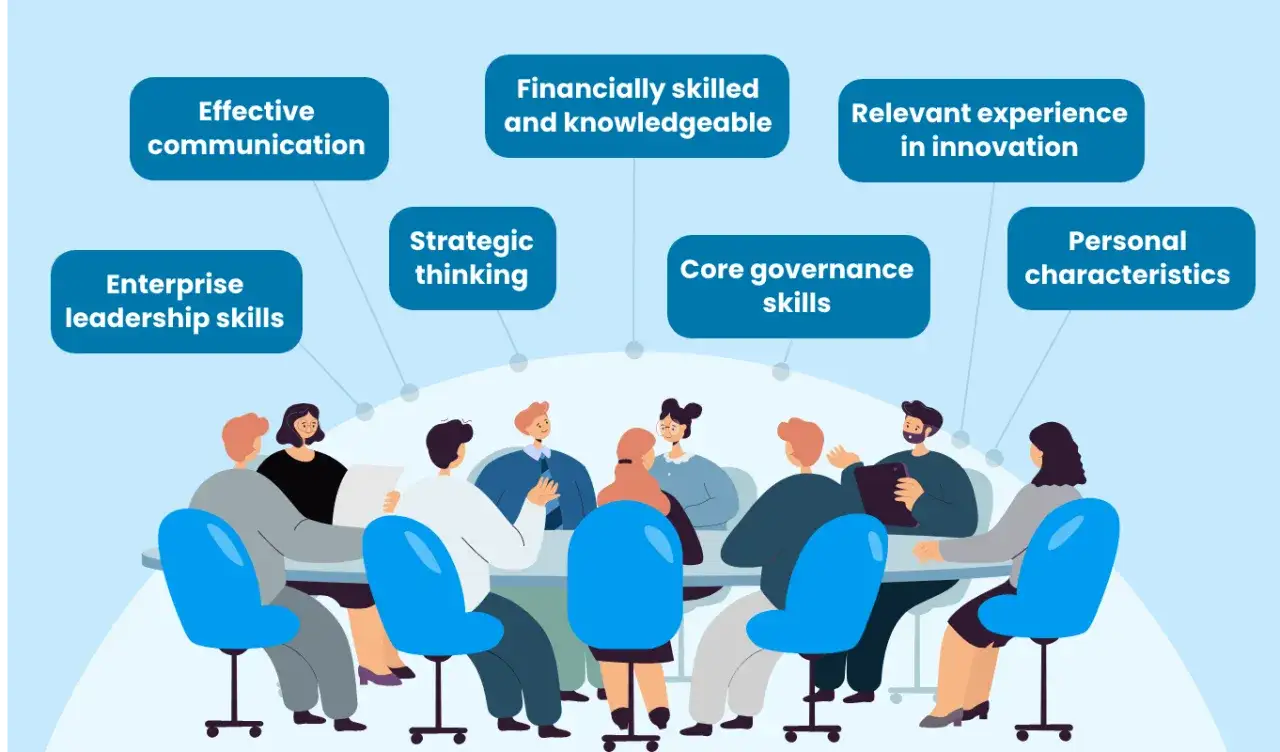
The chair role looks simple from the outside, but it is demanding in ways that are easy to underestimate. A polished speaker is not automatically an effective chair. I look for judgment, restraint, and the ability to keep the board honest about what belongs in governance and what belongs in management.
Strategic restraint
A chair needs enough strategic awareness to frame the right questions, but not so much ego that every issue becomes a personal project. The chair should steer the board, not replace it. When the chair starts solving everything, the board stops thinking.
Facilitation and pacing
Good facilitation is not about being the loudest voice. It is about making room for the quiet director with the sharpest insight, interrupting circular debate, and drawing the board back to the actual decision. In the best rooms, the chair makes dialogue easier without making it shallow.
Fiduciary literacy
A chair does not need to draft legal opinions, but the role does require a working grasp of fiduciary duty, risk oversight, and board authority. That literacy matters when the board is dealing with compensation, conflicts, succession, or any decision that could be challenged later.
Read Also: Board Evaluation - Is Your Board Truly Effective?
Succession mindset
The chair should always be thinking one move ahead. Who is ready now? Who needs another year? What happens if the chair steps away unexpectedly? If the answer is “we will figure it out later,” the board is already behind.
That is why underprepared chairs create so much friction. The problem is rarely intelligence; it is usually a weak pipeline and too little structured preparation. Once that gap is visible, the next step is to name the mistakes that keep showing up in real boards.
Where boards go wrong with chair leadership
The most expensive chair mistakes are usually not dramatic. They are quiet, cumulative, and easy to justify in the moment. I have seen the same patterns repeat across organizations of different sizes.
- Turning the chair into a second CEO. This blurs accountability and pulls the board into management territory.
- Using meetings for reporting theater. If every update is too long and every decision is vague, the board is not governing well.
- Letting one personality dominate. A strong chair should prevent overtalking and make space for dissenting views.
- Skipping succession planning. A board that waits until the end of a term to think about the next chair is already improvising.
- Ignoring the board culture. Poor tone, weak preparation, and unclear expectations eventually show up as poor governance.
These mistakes matter because they create habits. Once a board gets used to weak boundaries, it becomes harder to recover them later. The fix is usually not more effort; it is clearer design, explicit authority, and better succession planning.
How to appoint, support, and evaluate the chair
If I were advising a board on this role, I would start by making the expectations visible. The job should not live only in tradition or in someone’s memory. It should be documented, discussed, and reviewed like any other critical governance function.
- Put the role in writing. A board charter, bylaws, or leadership profile should describe the chair’s authority, responsibilities, and limits.
- Define the term and the pipeline. Boards should know how long the chair serves, what happens next, and who is being prepared as the next leader.
- Use a vice chair or chair-elect when it helps. That gives the incoming leader time to learn the rhythm of the board before taking over.
- Evaluate the chair regularly. A simple annual review, paired with peer feedback and input from the CEO, is usually enough to surface problems early.
- Give the chair real support. Good chairs need board materials in advance, a disciplined calendar, and clear committee coordination.
The governance lesson here is straightforward: if the board wants a strong chair, it has to build the role deliberately. That starts with role design and ends with consistent feedback, because a title alone never produces leadership. When those basics are in place, the chair can spend less energy on maintenance and more on the strategic issues that actually deserve board attention.
A chair checklist for the next board cycle
Before the next board cycle starts, I would check five things: whether the agenda is tied to the board’s real decisions, whether directors are actually prepared, whether the CEO evaluation process is clear, whether there is a visible succession path, and whether the board is still keeping governance separate from execution. If any of those answers is fuzzy, the chair’s first job is to restore clarity.
A board does not need a heroic chair. It needs a disciplined one, with enough authority to keep the room focused and enough humility to let the board do its best work. That is what turns a formal title into effective governance.